
Blog / 2026 Ford Explorer

2026 Ford Explorer vs. Escape: How Much SUV Does Your Family Need?

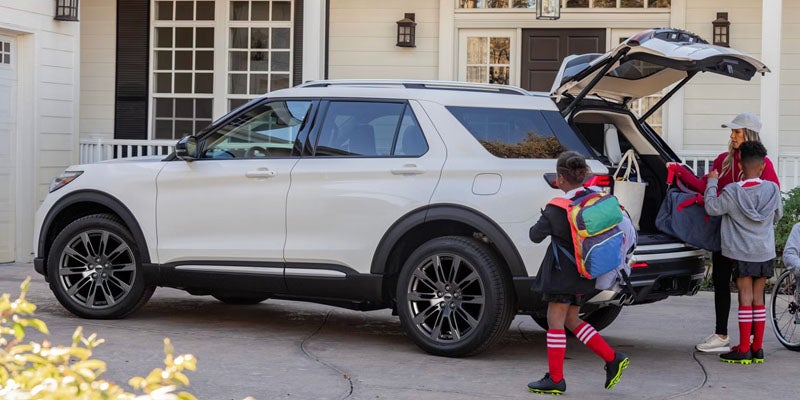
2026 Ford Explorer with children loading backpacks in driveway

The 2026 Ford Explorer® and Escape® may share a showroom, but they solve different family-vehicle problems. Explorer is the larger 3-row SUV, seating up to 7 and offering as much as 400 hp, 85.8 cu. ft. of maximum cargo space, and a 5,000 lb. maximum tow rating when properly equipped. Escape seats 5, takes up less space, and gives buyers 4 powertrain choices, including Hybrid and Plug-In Hybrid options. For North Aurora, IL, families, choosing between them starts with an uncomplicated question: do you regularly need the Explorer's extra capacity, or would you benefit more from the Escape's smaller dimensions and wider range of powertrains?


Explorer's Third Row Changes the Equation

Explorer provides something Escape can't: seating for up to 7 across 3 rows. With every seat occupied, there are still 16.3 cu. ft. of cargo room behind the third row. Fold the second and third rows and capacity expands to 85.8 cu. ft., giving Explorer considerably more room when the job shifts from carrying people to hauling gear. Escape uses its smaller dimensions efficiently, seating 5 and providing up to 65.4 cu. ft. of maximum cargo capacity in select configurations. That is still substantial space for a compact SUV, and the smaller footprint can be an advantage in parking lots and tighter suburban areas. If the third row will be regularly occupied, Explorer has the clear packaging advantage. If your family rarely carries more than 5 people, Escape avoids hauling around an extra row you may seldom use.


Four Escape Powertrains Versus 2 Powerful Explorer Engines

Explorer keeps its engine choices focused. Most models use a 2.3L EcoBoost® 4-cylinder producing 300 hp and 310 lbs. ft. of torque, while Explorer ST gets a 3.0L EcoBoost® V6 producing 400 hp and 415 lbs. ft. of torque, with the V6 also available on Tremor®. Both engines use a 10-speed automatic transmission, and RWD or Intelligent 4WD configurations are offered depending on trim. Escape takes a broader approach. Its 1.5L EcoBoost® 3-cylinder produces 180 hp and 199 lbs. ft. of torque, while the available 2.0L EcoBoost® 4-cylinder delivers 250 hp and 280 lbs. ft. of torque. The 2.5L Hybrid produces 192 combined hp, and the 2.5L Plug-In Hybrid reaches 210 combined hp with an EPA-estimated 37 miles of electric driving range. AWD is available with select gas and Hybrid configurations, giving buyers several ways to balance performance, traction, and fuel consumption.


Towing Creates One of the Clearest Differences

Every properly equipped 2026 Explorer can tow up to 5,000 lbs., making it the more capable option for families planning to pull a compatible boat, camper, or recreational trailer. That's an important distinction because towing isn't simply a question of horsepower. Vehicle structure, cooling, gearing, chassis setup, and the complete tow configuration all contribute to what an SUV can safely handle. Explorer's combination of stronger engine output and 5,000 lb. maximum towing capability makes its mission clear. Families shopping primarily for passenger transportation and commuting may find Escape's smaller dimensions and Hybrid or Plug-In Hybrid choices more relevant than additional trailer capacity.


The Technology Reflects Each SUV's Mission

Explorer's standard cabin technology includes a 13.2-inch touchscreen, 12.3-inch digital instrument cluster, wireless Apple CarPlay® and Android Autoâ„¢ compatibility, a 5G modem, and USB-C ports in all 3 rows. Ford Digital Experience integrates Google Maps and Google Play, while available BlueCruise provides hands-free highway driving on compatible roads. Escape offers an available 13.2-inch SYNC® 4 touchscreen, wireless Apple CarPlay® and Android Autoâ„¢ compatibility, available wireless charging, and an available 360-Degree Camera. Ford Co-Pilot360® technology can also provide features such as Adaptive Cruise Control with Stop-and-Go, Lane Centering Assist, and BLIS® with Cross-Traffic Alert, depending on configuration.


Choose Based on What You'll Carry Most Often

Explorer earns its extra size when a family needs 3 rows, more cargo capacity, stronger engines, or substantial towing capability. Escape makes a different argument with seating for 5, up to 65.4 cu. ft. of maximum cargo capacity, easier maneuverability, and gas, Hybrid, and Plug-In Hybrid powertrains. The important part is matching the vehicle to what you'll carry most weeks instead of buying around the one trip you might take once a year. Families around North Aurora, IL, can visit Gerald Ford to browse new Ford Explorer and Escape inventory, compare available powertrains and drivetrains, explore financing options, value a trade-in, and schedule a test drive right now to get behind the wheel.

Posted in:

Related Posts

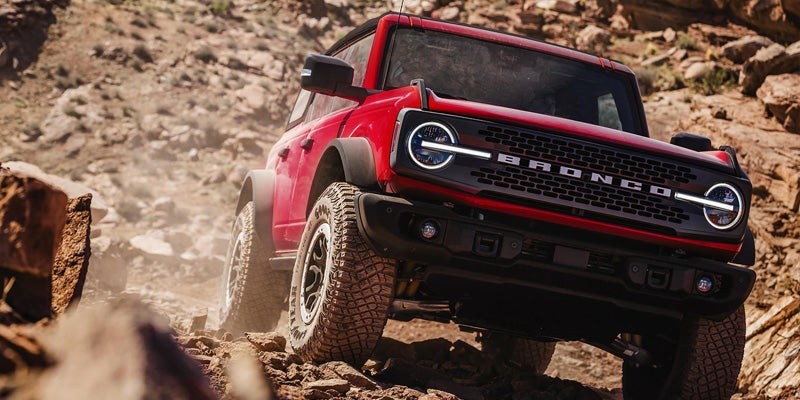
2026 Ford Bronco tackling rocky off-road terrain

2026 Ford Bronco vs. Bronco Sport: Two Different Ways to Get Dirty

Park a 2026 Ford Bronco ® next to a Bronco Sport ® and the family resemblance is obvious. Start looking at the hardware and the relationship gets more interesting. Both come standard with 4x4 and G.O.A.T. Modes®, but Bronco Sport is a compact, 5-passenger SUV with independent suspension and an 8-speed automatic. Bronco is a body-on-frame off-roader available with 2 or 4 doors, removable body panels, locking differentials, big tires, and even a manual transmission. Bronco Sport Wins When Space Gets Tight At roughly 173 inches long, Bronco Sport is compact enough to fit easily into suburban life while retaining enough cargo room for camping equipment, bikes, or weekend gear. Models with the 1.5L EcoBoost® provide up to 32.5 cu. ft. behind the second row and 65.2 cu. ft. with it folded. Bronco dimensions depend on body style. The 2-door seats 4 and provides up to 52.0 cu. ft. behind the front seats, while the 4-door seats 5 and offers considerably greater capacity. A 4-door hardtop reaches 77.6 cu. ft. of maximum cargo room, while the soft top stretches that to 83.0 cu. ft. Bronco gives you more room at the upper end, but Bronco Sport asks for less real estate everywhere you take it. Bronco Sport Badlands® Packs Serious Hardware into a Small SUV Every Bronco Sport comes with 4x4 and a Terrain Management System™ with G.O.A.T. Modes®. Most versions use a 1.5L EcoBoost® 3-cylinder producing 180 hp and 200 lbs. ft. of torque, but Badlands® is where the spec sheet gets entertaining. Its 2.0L EcoBoost® 4-cylinder produces 250 hp and 280 lbs. ft. of torque, while Advanced 4x4 adds a twin-clutch rear drive unit capable of directing torque across the rear axle. HOSS 2.0 suspension, metal bash plates, all-terrain tires, Trail Control™, and 7 G.O.A.T. Modes® complete the package. That's genuine trail equipment packed into a compact crossover architecture, making Badlands® far more than a Bronco Sport with tougher-looking trim. Full-Size Bronco Brings the Heavy Off-Road Toolbox Bronco begins from a more specialized foundation. The standard 2.3L EcoBoost® 4-cylinder produces up to 300 hp and 325 lbs. ft. of torque, while the available 2.7L EcoBoost® V6 raises output to 330 hp and 415 lbs. ft. of torque. Then there's Bronco Raptor®, whose 3.0L EcoBoost® V6 generates 418 hp and 440 lbs. ft. of torque because apparently 330 hp wasn't causing enough trouble. Select Bronco configurations add front and rear electronic-locking differentials, a front stabilizer-bar disconnect, 35-inch tires, and high-clearance suspension. The available 7-speed manual with the 2.3L engine gives drivers direct control over gear selection, while a 10-speed automatic is offered elsewhere in the lineup. Removable doors and roof configurations complete the transformation from SUV into something approaching a very large outdoor toy. The Smaller Bronco Gets the Bigger Screen Both models use SYNC® 4 with wireless Apple CarPlay® and Android Auto™ compatibility, although there's a mildly amusing reversal in screen size. Bronco Sport gets a 13.2-inch center touchscreen, while Bronco uses a standard 12-inch display. Bronco Sport Badlands® also includes a 360-Degree Camera with Trail View and Ford Co-Pilot360® Assist 2.0. Bronco offers its own trail-camera and driver-assistance technology depending on trim and package. Screens are nice, but off pavement the cameras earn their keep by showing obstacles that disappear beneath the hood line. Bronco Sport or Bronco Comes Down to the Trail Bronco Sport is the easier vehicle to live with when most miles happen on pavement and weekend exploration doesn't involve extreme terrain. Badlands® makes a strong case for itself with Advanced 4x4, a twin-clutch rear drive unit, all-terrain tires, HOSS 2.0 suspension, and underbody protection. Bronco starts farther along the off-road spectrum and keeps going, offering greater engine output, locking differentials, a disconnecting front stabilizer bar, 35-inch tires, removable body panels, and a manual-transmission option. One is a compact SUV engineered to be impressively capable off pavement. The other was designed around the idea that pavement might be optional. Compare Bronco and Bronco Sport at Gerald Ford North Aurora, IL, drivers can visit Gerald Ford to browse new Ford Bronco and Bronco Sport inventory, compare Badlands® and other off-road configurations, explore available 4x4 hardware and packages, review financing options, value a trade-in, or schedule a test drive online now. If your weekends involve little more than snowy roads and a gravel trailhead, Bronco Sport may supply all the capability you need. If 35-inch tires, locking differentials, and removable doors sound less like excess and more like a shopping list, Bronco is playing an entirely different game.